SHRUMANS INTERVIEW: PRAIRIE STATES MUSHROOM CLUB
Happy New Year! First, a special thank you to everyone who came out to support the December Holiday Markets in Iowa City! Thank you for braving our weather for small businesses.
I am happy to present an interview I did with the Prairie States Mushroom Club (PSMC). PSMC is a nonprofit Iowa-based group that as you might guess loves all things fungi! I spoke with the wonderful Loulwa, who took our transcript and made my garble of words worthy of reading.
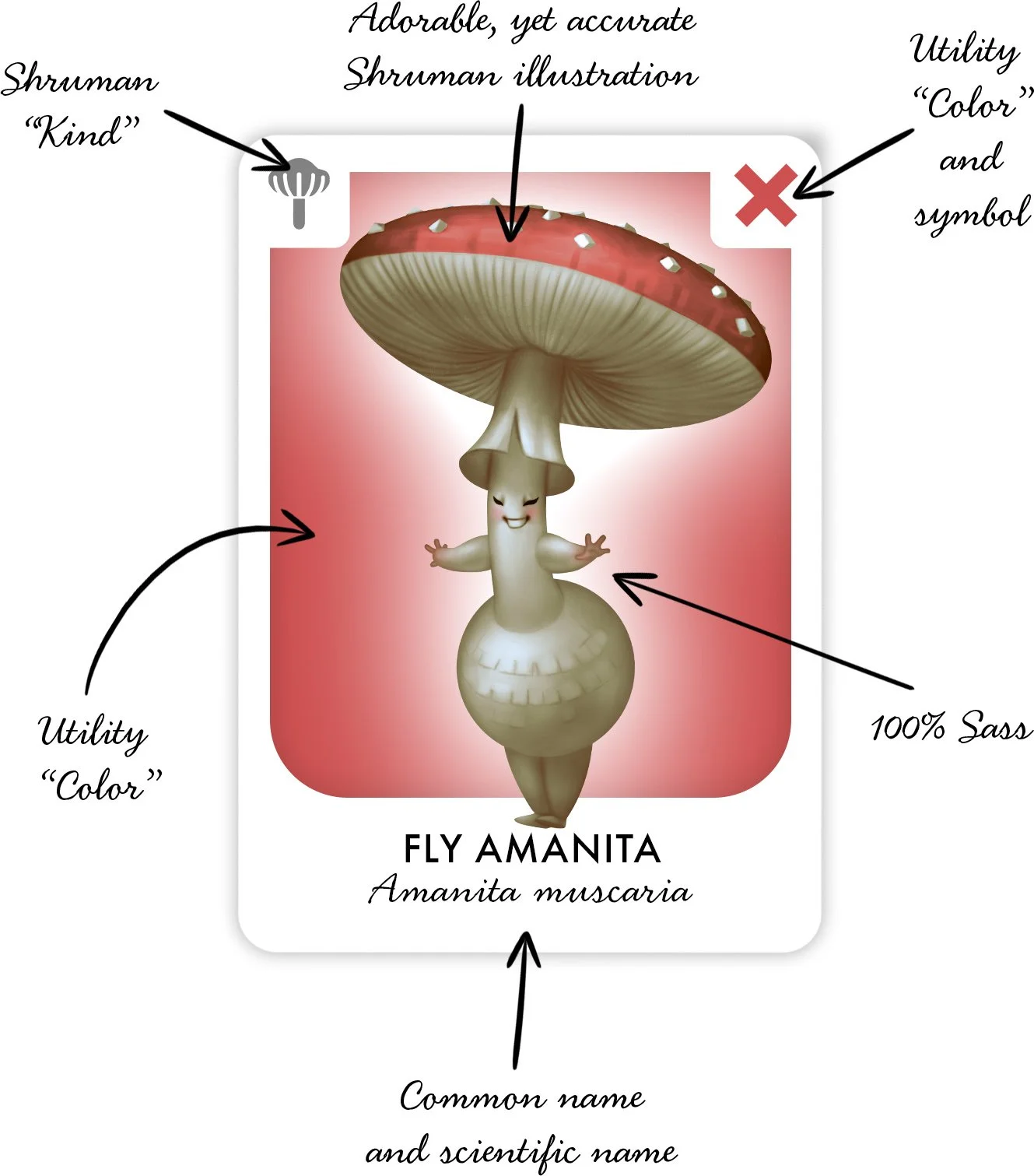
An Interview with Shrumans Creator Candice Broersma
by Loulwa Soweid
Foreword: On March 25, 2025, the Prairie States Mushroom Club had partnered with Iowa City’s FilmScene to host a showing of the film Fungi: Web of Life. I was manning our table outside the theater— with some fellow PSMC board members when I noticed another vendor nearby, her table stocked with gorgeous mushroom drawings, stickers, and information about a mushroom-themed card game entitled Shrumans. “What an awesome idea,” I remember telling Sarah, “we should go talk to her and ask more about that game, and maybe see if we can host some events together.” Also, I just really wanted to get a closer look at the wonderful fungi art she had created. And that was how we met the lovely and multi-talented local illustrator and fungi-enthusiast Candice Broersma, who has since joined us on many forays, held several Shrumans game-testing events at Diversions Tabletop Game Lounge, and graciously agreed to be interviewed for the following Symbiosis article! Please note that edits to the original transcript were made for the sake of clarity and conciseness.
Loulwa: If I asked you to tell me about Shrumans, where would you start?
Candice: I had the Shrumans character designs made for an app project that my husband was working on. Then I tried to branch out by making iOS stickers for Messenger, but it didn’t quite work because I wanted to animate them, but the file size was too much, and the whole interface for coding stuff for Messenger is really tricky (also, getting an account for the app store is way too expensive if you’re not making anything from your apps). So that just didn’t work out. That’s okay -- on to better things, like physical stickers! That just seemed like the natural extension. And then, I had been wanting to do a project consolidating my art into one thing. And I was looking at Shrumans, and it just seemed like they could do so well for a card game based on mushrooms, and the isolated characters are fun, they’re playful, so—
Loulwa: Here we are!
Candice: Here we are. Just this year I was like: I’m going to make a card game. I went through a lot of variations on gameplay. Right now, Shrumans uses basic card game mechanics for simple card groupings. I had thought of some other ways before, like could I do a collaborative card game instead of a competitive one? But it just made more sense to do this more traditional style competitive card game, with all of the very familiar card game mechanics. I think people playing it will pick it up faster, which is what I want— I want it to be playable for all ages.
Loulwa: So, the different kinds of mushrooms in the game— if you were just trying to explain what those were to people, how would you describe them?
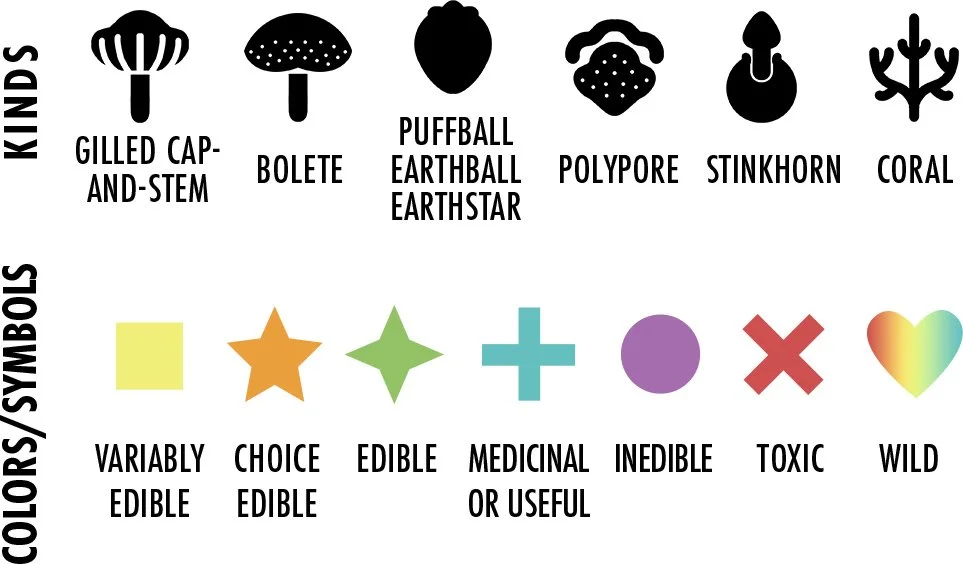
Candice: The “kinds” are major groups of mushrooms that are based off the appearance features rather than specific scientific categories. For example polypores: you have shelf polypores and then you have other kinds of polypores that are totally unrelated on a scientific level. Then you’ve got the cap-and-stem mushrooms, like the boletes. And then I put puffball, earthball, and earthstar into one category because I saw a prominent mushroom website where they put them in the same category, so I was like, okay, I want things to have a consensus even within the scientific community, because I do want people to learn about mushrooms and understand them categorically in a way that makes sense.
Loulwa: What about what the different colors mean?
Candice: The colors relate to the Shruman’s utility, is the best way to describe it. You could also say their edibility, although there’s another category of color that is related to their medicinal use or what they are “useful” for. For example, some mushrooms are used to dye fabric and yarn.
And regarding edibility— sometimes you’ve got mushrooms that vary even within edibility. Sometimes they’re edible only when they’re at a certain state before they are fully matured. And then some are edible, but they’re not very tasty and we don’t really eat them. So I made an attempt to categorize these mushrooms into those edibility categories, which is hard because I think there are still some varied opinions on what is considered choice edible or not really edible. For example, stinkhorn eggs are really big in some places like the Czech Republic, but we don’t eat them here. But I think generally, I will try to find what is the most common or agreed-upon designation for particular mushroom edibility.
Loulwa: What about the “ecology” option?
Candice: The ecology is related to how fungi get their nutrients. You’ve got mycorrhizal, which is mushrooms that get their nutrients by forming bonds with tree roots. And then saprotrophic is they get their nutrients from decaying organic matter. And then parasitic is when they consume the energy of a living thing, usually to the detriment of whatever it’s living on. There are some other ones too. And then there could be some fungi that may not be parasitic, but if it’s in a large enough quantity could actually destroy a tree. Some of the fungi, I do have multiple categories of ecology where I did both saprotrophic and parasitic.
Loulwa: I appreciate that you did that because sometimes it’s not super cut and dry. Can you tell me about the action cards?
Candice: Action cards are a way to try to thwart your opponent’s attempt at building sets. And they can also be used to help you build your own sets. The action cards, in addition to helping strategically, relate to fungi in some way. You have a parasitized card, and it’s based off of fungi that can take the nutrients of another living organism using parasitism. I tried to make them a little educational, and they can be a little whimsical too. I’ve got the fairy ring, which is a phenomenon too. You see mushrooms pop up in a little magical circle, which it probably has a scientific name for, but I call it a fairy ring because it’s a way cooler name for an action card.
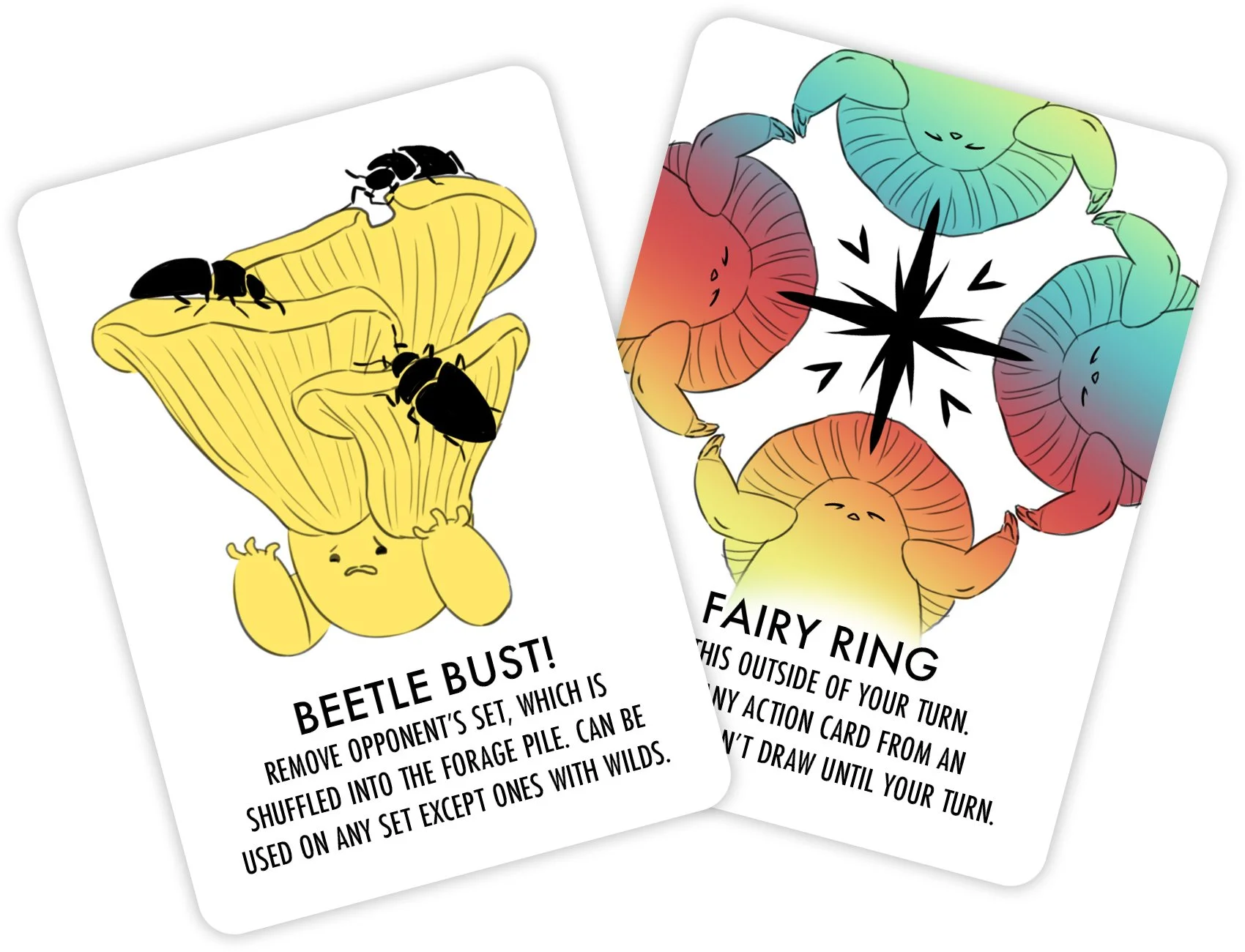
Action card prototypes from Shrumans: The Card Game
Loulwa: Oh, I see there are “beetle busts”, too. I love that!
Candice: There are a lot of things that fungi and bugs do together, so I think it’s super important to have something related to bugs as an action card. Even though in the card game, the beetle bust action card is technically a bad thing, in reality bugs can be also involved with positive things like carrying the spores of some kinds of fungi, like stinkhorns.
Loulwa: Before you created this game, did you know a lot about mushrooms and fungi already? Or did creating this game involve a lot of research?
Candice: I knew a little bit. I knew what is edible, because around the pandemic, I did a lot more foraging for both fungi and other kinds of edible plants. I grew up in southern California, which is mostly desert unless you take an hour drive up to the mountains, so I didn’t get to see up-close the variety of mushrooms that really like forested areas. Coming to Iowa and seeing how green it is and how many plants there are was shocking to me. And people don’t think of the Midwest as being this very lush, forested area, but we have some really nice places. It’s not the redwoods, but it doesn’t have to be. I think it’s just as good. We have just as many mushrooms.
During the pandemic, I lived so close to so many little parks, which made foraging a great activity. And I think that starting the game, I learned a lot more, especially the ecology of fungi and other things they do. So yeah, I learned gradually over years, and then a lot more once I started the game.
Loulwa: What did that look like, the research process that you went through as you were creating the game? And where were you looking for that information when you were learning about the different fungi and their edibility and their ecology?
Candice: The website mushroomexpert.com was really good. It has some nice categories to search within. And also, I read some of the articles, and they are hilarious. I don’t know what it is, but mycologists are hilarious. I also have a couple of mushroom books, and those were good for having a baseline understanding of how people categorize mushrooms by edibility. One book was How to Forage for Mushrooms Without Dying, I think that’s the name.
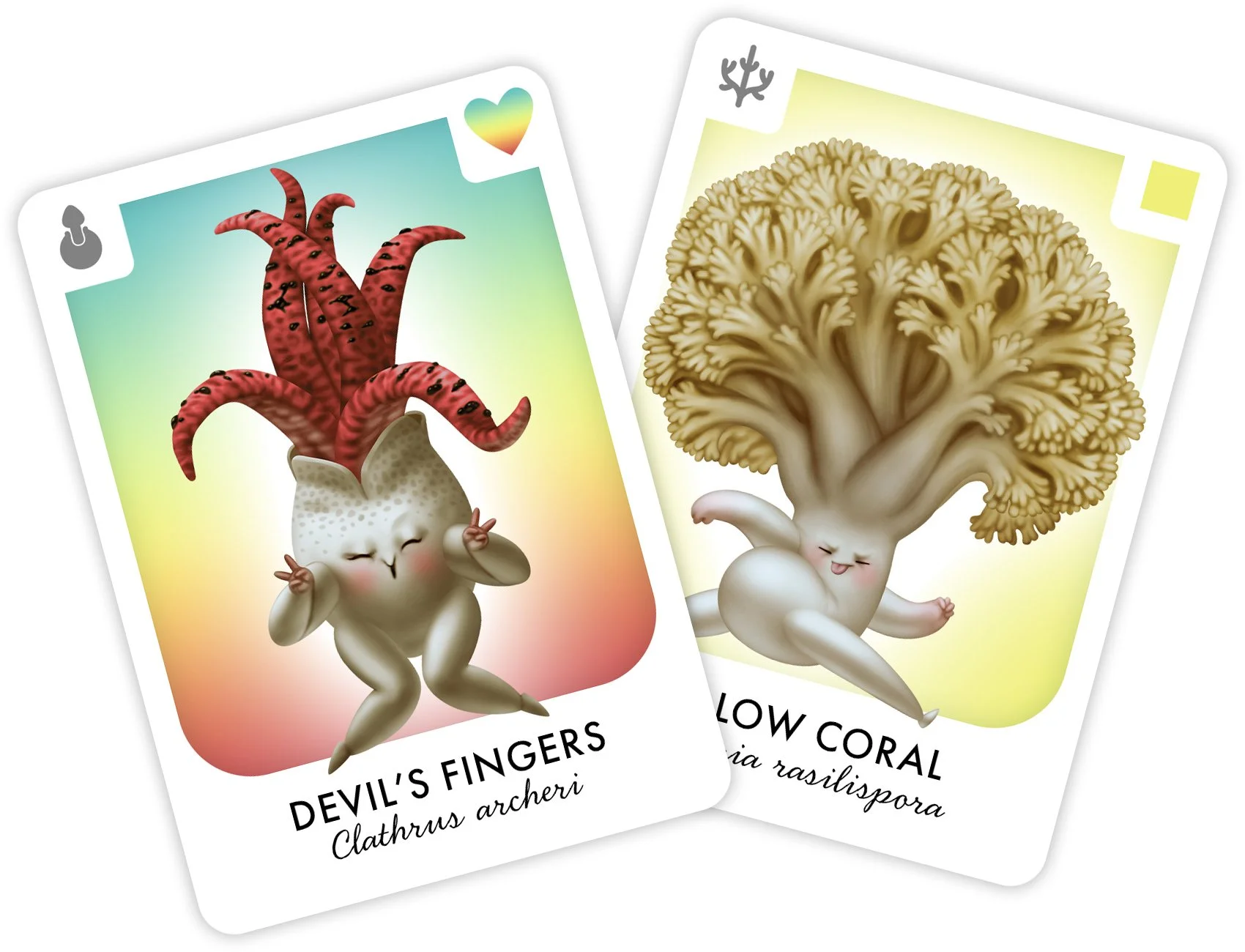
Card Prototypes from Shrumans: The Card Game
Loulwa: Something that I’m really interested in is the fact that you didn’t just draw mushrooms, you drew mushroom humans, or “shrumans”. And I was wondering why you chose to do that as opposed to making a card game where the mushrooms were just mushrooms as opposed to little “shrumans”?
Candice: I think because we connect to things that have a face. And you can do a lot more with the character by giving it a personality. And I think watching people play the game, it warms my heart to see them come across a card that they just think is really funny or they’re like, "that’s me as a mushroom." I think that it adds another level of enjoyment, and I think it’s just really funny to put a face on something inanimate.
Loulwa: I was wondering how you went about connecting a personality with a certain Shruman because when I was going through them, their personalities shined through so well, and they’re each so unique. How do you choose which mushrooms are sneaky, and which mushrooms are more serious?
Candice: I think that there’s something within us as people where we are going to give something a personality just by how it looks, like the color of it, because colors are so related to emotion. And then if it has curvy shapes versus spiky shapes or if it has sinister quality, if it’s black or gooey, all of these things are related to the personality. And sometimes it’s easy. Something that’s spiky, mean-looking, I might make it a grumpy mushroom. But sometimes I do the opposite just to be contrarian, just be like, "You know what? This is not a very attractive looking mushroom, but I’m going to make it super attractive." For example, devil’s fingers look creepy and like an alien, but I made that Shruman so kawaii. Because you know what?Sometimes we should look at a mushroom in a different way. I also want to make sure there’s enough variety– maybe there’s a personality that’s suited for a particular fungi, but I need to have some more of a different personality, so I try to add a little variety to it as well.
Loulwa: What would you say is your favorite Shruman?
Candice: I think it’s the bolete.
Loulwa: Oh, the red-pored bolete with a snail on top? I love that!
Candice: I think I love duos, like little sidekicks. One of the stinkhorns has a butterfly, which is very appropriate. And there’s also a stinkhorn with a fly– I forget what fly it is. It’s the iridescent ones that are really attracted to stinkhorns.
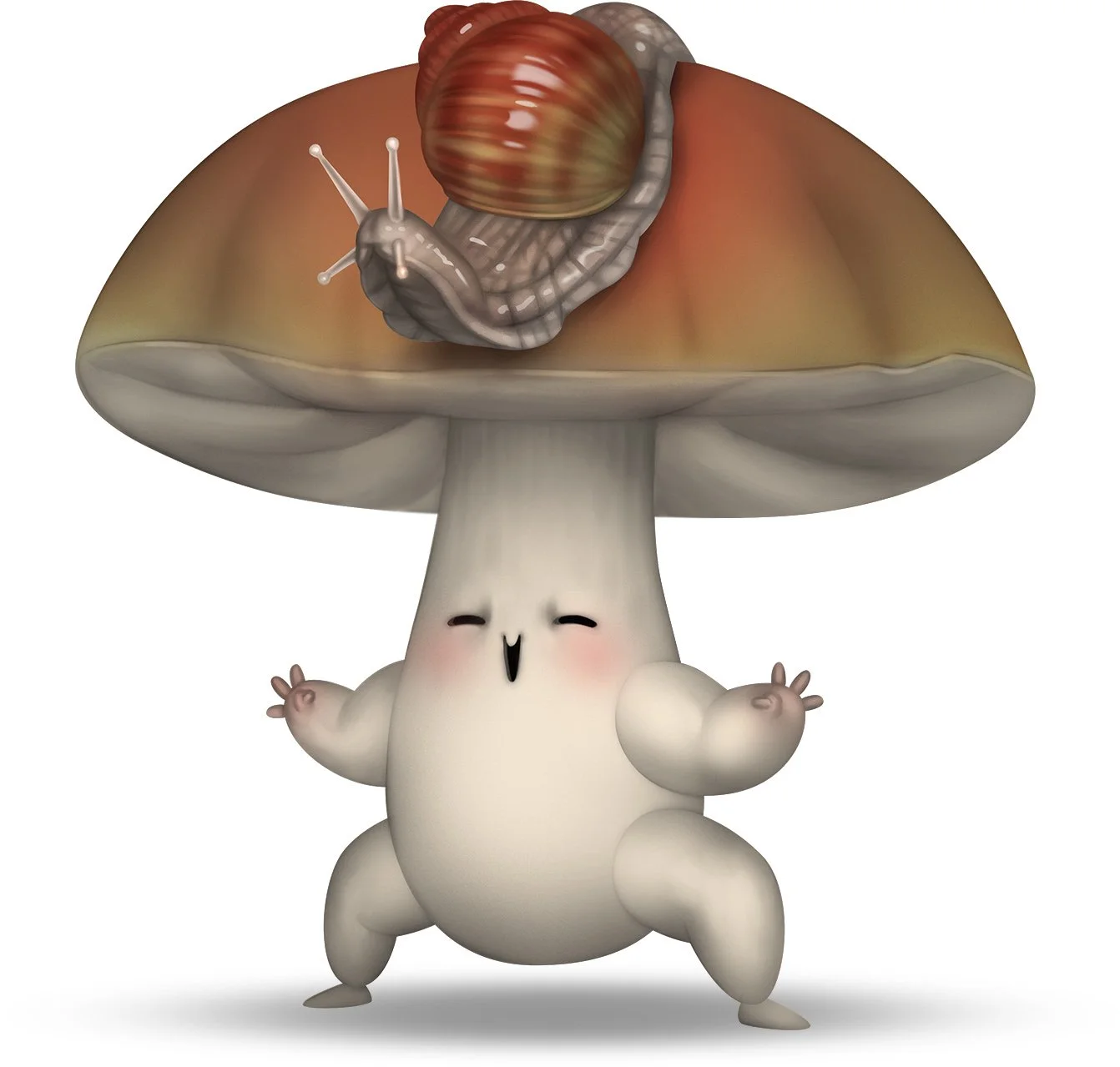
Shruman illustration representing King Bolete, Boletus edulis
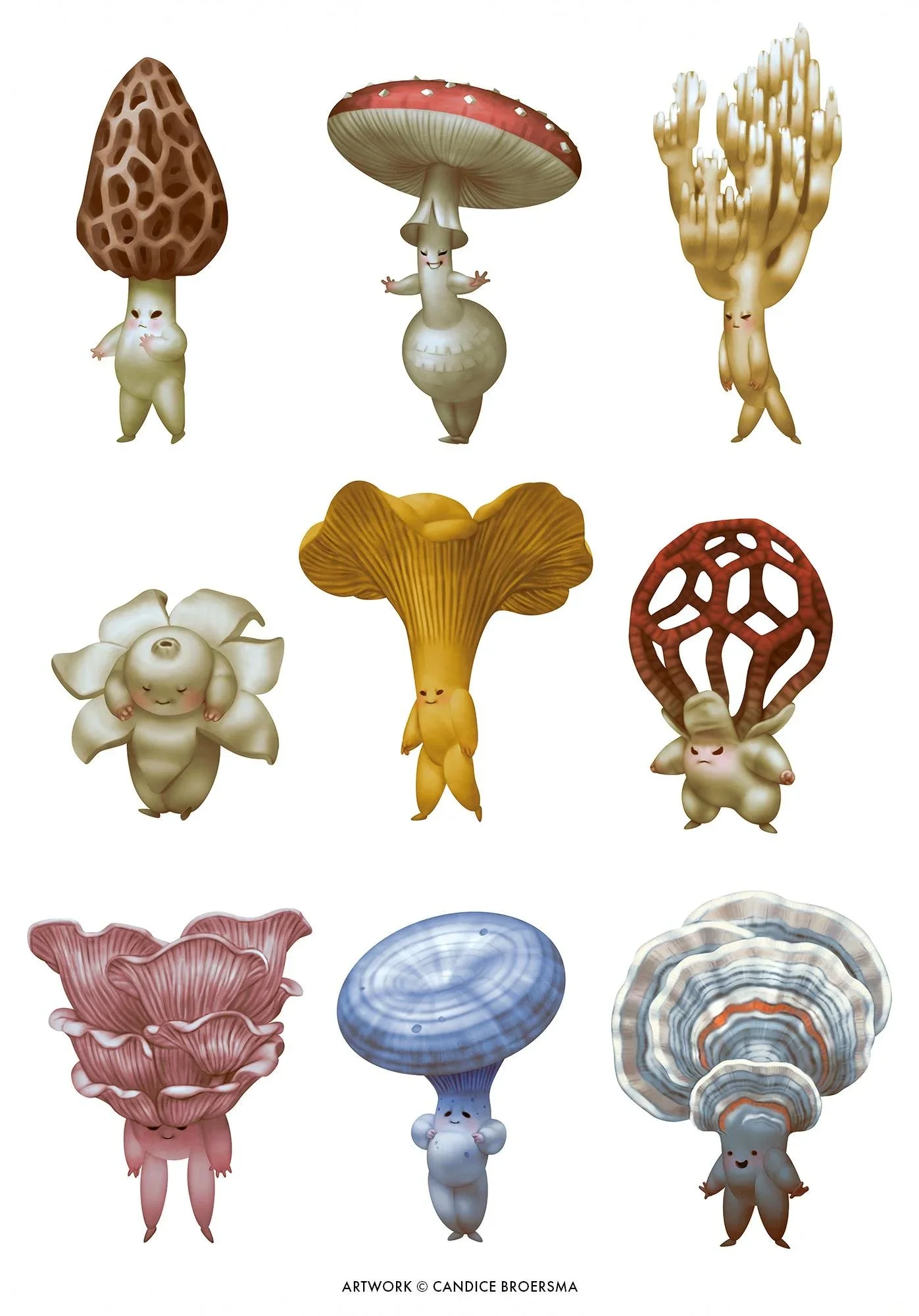
Loulwa: There was one I saw yesterday when I was looking at your website, and it was taking off its cap like it was a hat– I thought that was a really cool take on the mushroom cap! My next question is, how many Shrumans are there all in all?
Candice: I think there’s 40-something Shrumans, and I have plans to do more, and to do expansion packs to try to cover more varieties, because we don’t have Cordyceps, we don’t have jelly fungi. There’s a lot of other fungi to be drawn! Although some of them I haven’t done yet because I was like, "I don’t know how I’m going to draw that." Cordyceps, for example, I don’t know how to put a face on their super thin stalk/stem, which is a logistical challenge I’ve got to figure out. It’s a challenge. But I’ll find a way.
Loulwa: That actually segues so nicely into my next question about the process of illustrating the Shrumans. Did you run into any other challenges when you were illustrating them? And what did you find particularly enjoyable about drawing them?
Candice: One of the challenges is getting consistent style. I try to keep proportions similar with the face-to-fungi ratio. They do have small faces, which I think is cute and adds to the character design, and also, by making the face small, you pay attention to the other parts of the fungi, because I’m putting a lot of detail into the caps and other elements of its anatomy so that it would be close as possible to what you would find in nature. You’ve got that part that’s pretty prominent.
And it’s convenient when you’re working digitally to be able to reference your previous designs in a direct way. I’m also doing these characters without building a model. I take the photo of a mushroom or a couple mushrooms as reference, and then I’m using my understanding of lighting to shade the characters. And fortunately, these are very simple shapes. You’ve got spheres, which are easy to shade in a sense because if you know how to shade a sphere, you could probably learn how to shade a mushroom.
Loulwa: And I know this isn’t technically about Shrumans, but you’re an incredible illustrator, and I am just wondering, have mushrooms come up in some of your other illustration projects?
Candice: Yeah, they do make an appearance every now and then. I did a personal project that was a cover for Alice in Wonderland, and there were some mushrooms in there. I do like to draw botanical elements, so generally that is a fun thing I like to add illustrations when it makes sense. But yeah, if it is a forest, I will try to draw mushrooms. Oh, and I did a chipmunk character, and there’s a whole big shelf of polypores behind it. It’s the prominent feature of that particular situation.
Loulwa: I also just wanted to ask about mushrooms in general, as a source of inspiration.
Candice: I think they’re great! There’s just so many. And I think that it relates to another area of interest of mine, which is insects. They similarly have so many varieties, they’re also small, and you can forget they’re there until you look closely. They’re mind-blowing, what they do, how they procreate, and how they survive and just live amongst us. I think that that was my first passion. And mushrooms remind me a lot about that time when I was exploring the garden and looking for bugs. I think that it’s just a lot of fun, the discovery part.
And then you can dig deeper and still find more things, like spore shape is so cool. That’s not really something that I can highlight in the game, but I do think that it is way cool. Just all these things about fungi that I think people can learn about, figuring out whether they could eat it, learning a lot more about what they do in an environment, how they talk to each other.
Loulwa: Is there anything else you want to tell us about Shrumans, the process of creating it, the inspiration behind it?
Candice: I do think that it’s a developing thing that could end up changing, which is totally okay because when you’re trying to make something like a card game, you got to be okay with going to scratch with your idea. And I had to do that a few times before understanding that the card game makes sense in this particular game mechanic. I want people to enjoy it. I got a lot of feedback from doing a game testing night at Diversions, so that helped me find some of the issues and fix them. What people have been telling me so far has been very encouraging. It’s nice to see people, even in the game testing stage, finding something that they like about it. After I finish the art, I’m going to do another round of game testing to wrap that up.
This is my card game. It will be my first Kickstarter, first thing out in the world that’s interactive, so that will be pretty cool. Hopefully it gets there and it gets launched. I just can’t wait to share it.